
「九津見房子 凛として生きる」 堀和恵 (2011 郁朋社)
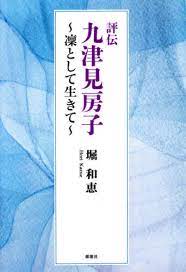
Reading the biographical novels of Yamashiro Tomoe, I run across many interesting people and have to sidetrack to learn more about each of them.
Kutsumi Fusako was an activist and member of the then illegal Communist Party in 1930s Japan. She is known as the first woman to be arrested and imprisoned for violation of the Chian Iji Ho ((Maintenance of the Public Order Act), a law passed in 1925 to suppress dissent under the increasingly militaristic government in Japan.
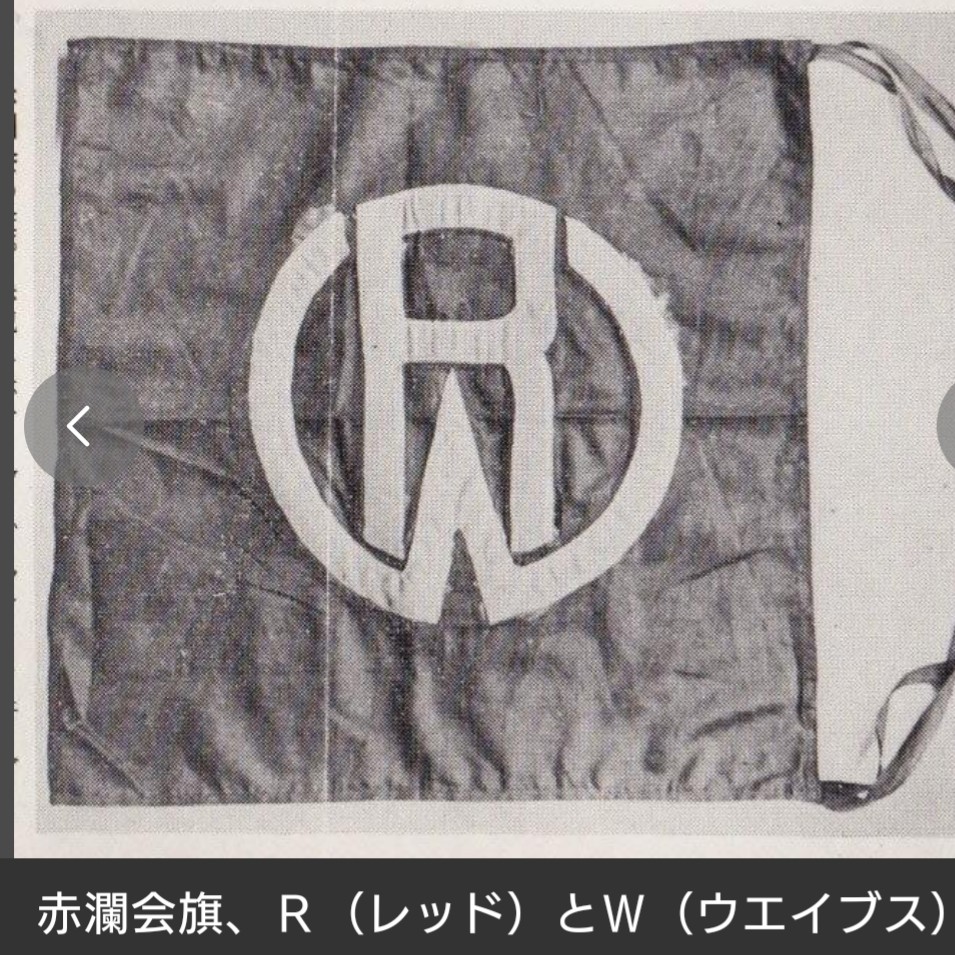
However, I think it is important to remember her as the leader in forming the first women’s socialist group in Japan, the Sekirankai (関蘭会)in 1921 along with Sakai Magara and Itoh Noe. On the Second May Day March held in Japan, these women carried a black flag with the red logo “RW” ( Red Wave) emblazoned on it. All were arrested immediately and made sensational news in the next day’s paper.
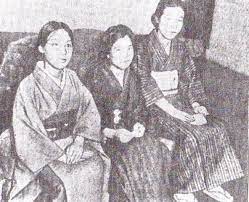
赤瀾会,左から山川菊栄、伊藤野枝、近藤(堺)真柄
Born in Okayama (岡山市弓之町)in 1890、her maternal grandfather had been a karo (chief retainer) in Katsuyama-han(勝山藩). Her parents divorced when she was 3 and her mother, a licensed midwife, opened an obstetric clinic in Okayama. Fusako attended a Catholic kindergarten nearby. When she was 5, she contracted dysentery, an often fatal illness. The priest from the school forced his way into the quarantined house insisting that Fusako be baptized so she could go to heaven if she died. This enraged her mother, a dedicated Buddhist, and she thereafter put Fusako into the local school. Nevertheless, the Christian ideals she had learned at an early age influenced her and encouraged her throughout her life.
Fusako later entered a girl’s high school in Okayama. A medical student who boarded at her home lent Fusako a copy of Edward Bellamy’s “Looking Backward 2000-1887” (100年後の新社会)and she began to be interested in social issues. This medical student was doing volunteer work in the minority burakumin community in Okayama and Fusako assisted him.
One day, on her way to school she noticed a poster for a lecture held in the Shokakuji temple (正覚寺)。She decided to attend and was the only woman there. Afterwards she met the speaker Yamakawa Hitoshi (山川 均.)She was 16 years old and she soon decided to leave home and go to Tokyo, staying with the widowed socialist and activist Fukuda Hideko. (福田英子)While there she helped with housework or printing of “Seikai Fujin” ([世界夫人」) While living there she often met people involved in Socialist causes like Uchimura Kanzo, Kanno Sugako, Sakai Toshihiko, Kotoku Shussui and Arahata Kanson.
Returning to Okayama only for her father’s funeral, she stayed and lived with her mother until 1911. Then she was alone and had no qualifications to support herself. Uchimura Kanzo introduced her to an evangelist in Osaka, Takada Shuzo. Takada was preaching a brand of Christianity mixed with Buddhist principles so his wife had left him. Kutsumi went there to assist him in his work but ended up marrying him as his common law wife in 1913. They had two daughters but Takada refused to work or support them. He believed that “God will provide all our needs,” and so it’s not necessary to work. The family was now living in Tokyo and Kutsumi worked in a kimono tailoring shop to support them. She divorced Takada in 1920.
She was asked to help with the printing of an illegal version of the “Communist Manifesto” and this provided the impetus for her to join the Socialist movement again. She met Mitamura Shiro (三田村四郎)and eventually married him. Relocating in Hokkaido, the couple continued to recruit people to the worker’s cause. This drew the attention of authorities as the government was cracking down on socialism on the eve of the invasion of China. Not only Kutsumi but her 14-year-old daughter, Itoko, were arrested and held. Stripped and beaten by the Special Political Police (特高警察), Kutsumi nevertheless refused to give up any information, only saying ” I don’t know” or “I forgot.”
Kutsumi was sentenced to 5 years and 4 months in prison for violation of the Maintenance of the Public Order Act. This roundup of Communist sympathizers is known as 3・15, having taken place on March 15, 1928. Her daughters were taken in by friends and later by their father.

After release, Kutsumi lived quietly with her daughter. In 1936, she was asked by someone she formerly knew to help with the work of a young American Communist named Miyagi Yotoku. She met to discuss it with Miyagi and Takakura Hikaru several times. They were being followed by the police, she was arrested in 1941 for collusion with the Russian spy Sorge (whom she had never met), and sent to Wakayama Women’s Prison with an 8 year sentence. There she met Yamashiro Tomoe. Kutsumi was released from prison by the GHQ in 1945 after serving 4 years. She spent more time in prison than any other female activist in Japan.
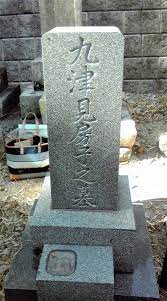
Kutsumi spent her latter years living with her daughter’s family in Kagurazaka. Her home is now a cafe called Kissa Tonboro (喫茶トンボロ)She didn’t participate in politics but was strongly anti-war and kept reading “Akahata Shinbun“. Of her motives in life she said
“The basis for my 80 year beliefs was Christ’s teachings. …..The idea of loving others was the biggest influence on me.” (p. 174) I thought again how that many of the social activists of the Taisho and early Showa eras were, at least at one time, Christians and that it certainly influenced their work in reforming factories and social conditions.
While this book did not give new insight into the life of Kutusmi, it was very readable and told the story of her life and her experiences in a way I could comprehend and enjoy. I highly recommend it.





 Baba's Kitchen